It’s very important to plan your website structure so it’s optimized for SEO.
Learn how to boost important pages by putting them high in your menu hierarchy, so search engines can match searches to your website.
SEO is the process of optimising your website to improve its chances of ranking highly in search engines’ organic search results. Example: If you type the term “buy dog toys” into Google, and your website sells dog toys, it’s the process of getting your website to be one of the first few search results Google offers to the searcher. These are called ‘organic results’, and users click on them more than paid Ads.
SEO is a complicated process that takes consistent and ongoing input and tracking of your results. You need to conduct thorough keyword research, update your website regularly, target keywords with pages and blog posts, and ensure you offer the best user experience possible, to stand of chance of ranking highly in organic search results.
Decide how SEO will be implemented on your website during the planning, so your site has the best chance to rank in search results.
Good SEO planning will start your website out on a good footing so you can build upon it.
Websites are built for a purpose – you want your business or organisation to be found online.
Once you have users on your website, you can guide them to buy products, signup for your news, and tell them more about your products and/or services, but they FIRST must land on your website. SEO can get them to land there.
SEO is one of the most important and effective ways to market your website. It’s the place to start if you want to attract new users, so it makes sense to consider it carefully when planning a new site.
If no one knows your site exists, no one can visit it. If it starts to show up in search engine results, people can find it and visit it.
1. Keyword research during website planning
The first step of any SEO is keyword research. This research will show you what users are searching for online. It can show you the words or phrases they use, how many times they search, and where they are searching from.
Keyword research will help you to compile a list of search terms that people are searching for. If you know what your potential users are searching for, then you can build a website that answers their searched questions.
2. Using keyword research to plan your website menu
Your main website menu is one of the most important elements of your entire site. It should explain what you do SO CLAERLY that if user didn’t read anything else on your website, they’d still know exactly what you do, from your menu alone.
Websites used to use their five favourite pages: Home, About, Services, Blog, Contact. You can easily see how these words are so generic that they could apply to any business! This is what you’re trying to avoid. Your menu should be extremely specific, and the menu items should include your website’s main target keywords.
It’s not easy to distil your entire business down to a menu, but Google gives great weight to the wording of your menu. Your menu items are usually the headings of your main pages and are therefore the headings of the most important information your site offers. These headings (and pages) should be about the target keywords your site wants to rank for.
If you match the keywords people are searching for, to the main pages on your website, and therefore the main menu items, Google is far more likely to rank your website in its search results so users can find you.
3. Menus are hierarchical
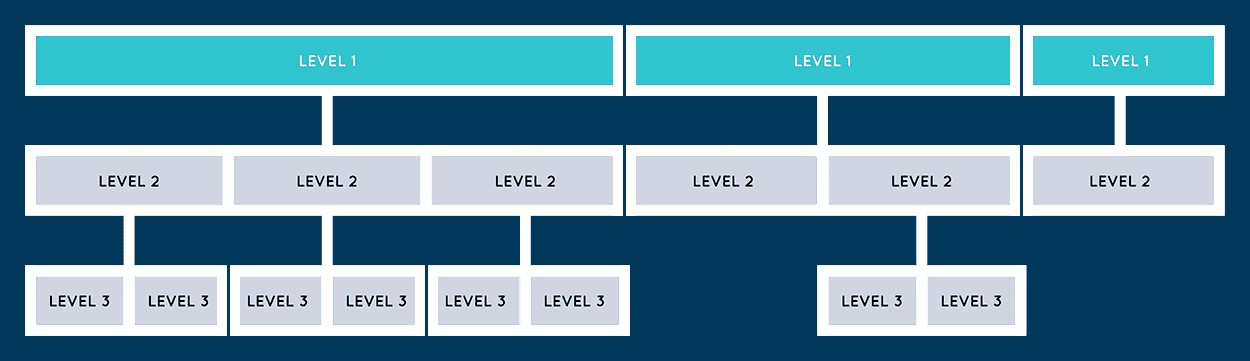
Menus are hierarchical, which means that the most important information appears in the first line and moves down in importance as you drop to lower lines.
Therefore, the structure of your menu is crucial.
It’s extremely important to plan this out during your website planning phase, as it will determine what content you should write for your website, and where it should go.
Example: Your home page is usually considered to be the main page your users will see if they look for you specifically online and includes a brief overview of your entire organisation. Then the rest of your information flows from there.
Let’s use a shop selling dog products as an example.
Their menu structure might look something like this:
- Home
- Buy Dog Toys (this is the shop)
- My Account
- Shopping Cart
- Book Dog Training
- Training Course 1
- Training Course 2
- Training Course 3
- Book Dog Care
- Dog Day Care
- Overnight Stays
- Long Stays
- News
- About
- Meet our Team
- Contact
Your menu forms the main structure of your website. There might be additional pages (like blog posts) but all the MAIN pages should be included in the main menu.
Including your main pages in the primary menu will help your SEO in several ways:
- It creates a better user experience because information is easy to find.
- The hierarchical importance of pages is clearly evident to both users and search engines.
- Important pages should be within 3 clicks of your home page. Your menu is on every page because that’s usually how websites are structured and is expected by your user. By including your main pages in your menu, all your important pages are within 3 clicks of your home page and are accessible from anywhere.
4. Target keywords should be in your main menu
Your target keywords are the main search terms you want your website to rank for.
By making your target keywords your main page headings, you’re telling search engines what your website is about. You’re also telling them that your content matches the search terms people are using. You are ‘connecting’ your content to online searches.
You are also displaying how important each target keyword (or search term) is on your site, by showing its position on your main menu. The higher up the keyword is, the more important it is. The lower down it is on your menu, the less important.
When planning your menu, it might be easier to visualise the importance of pages by laying it out like this (please click to enlarge):
5. Match your user’s search intent
‘Search intent’ is the reason someone searches for something on the internet.
It’s sometimes very easy to determine – example: “buy dog toys for poodles” is quite easy to understand. The user is obviously looking to buy dog toys for a poodle.
Other times, search intent can be more difficult to interpret – example: “dog breeds”. This search could mean any number of things. The user might be looking to acquire a new dog, or they might want to learn about dog breeds, or they could be looking for something appropriate to buy for a particular dog – it’s very difficult to know.
However, you should do your best to build a website that answers the LIKELY search intent for YOUR target market, with one of your website pages.
This is why we use page headings like ‘Buy Dog Toys’ in a shop that sells dog toys. We could just call the page ‘Shop’ but that doesn’t match as closely with the user’s search intent when they are searching online.
6. Optimize ONE page per target keyword
Each important page on your website should be optimized for its own, unique keyword. i.e. Don’t optimize more than one page for the same keyword.
Note: We use the term ‘keyword’ to also mean key phrase, because when we speak about keywords, we are usually referring to phrases. These are sometimes called longtail keywords and are a phrase, instead of a single word. Choosing single words as target keywords is usually fruitless unless you have a massive marketing budget, because they are too general for the average company to rank for.
If you optimise several pages for the same keyword, these pages will be competing against each other in search results. That might sound like a good thing, but it actually diminishes the quality score of each page that’s in competition with another on your website.
When you optimise one page per keyword, you are pumping all the valuable information you have about that keyword into a single page. This makes it a good option for search engines to offer in their results, and you’re giving it that best possible chance of ranking well.
Is it now clear why SEO is so important when planning a website?
The structure of your website lies in your menu layout.
It’s important to showcase your most important pages high up in the menu hierarchy.
This way, users and search engines can easily see what your site is about. They can also immediately tell which is the most important content.
Then search engines can match users’ searches to your website content.
Plan your website structure and menu very carefully before you start your website build. Once you have a menu that’s optimised for search engines, you can write the most useful content for each page.
By doing this, you are making sure that the very foundation of your website is optimised for search engines, and your website is much more likely to be found online.